Launched just one year ago, the Einstein Learning Communities Program (ELCP), which offers weekly small-group instruction and hours of one-on-one attention, is already garnering rave reviews from both medical students and faculty.
“The ELCP has been transformative for me,” says Cassidy Adams, a second-year medical student and a self-described introvert. “Starting from day one of medical school, it gave me a group of people who made me feel comfortable, a group I was not afraid to make mistakes in front of during potentially embarrassing situations, like when I had to perform a physical exam. We got to know each other really well.”
Her classmate Jalen Crespo agrees. “The ELCP has given us a very tight-knit community of people to share our journey with, from the beginning of medical school to the end and even afterward.”
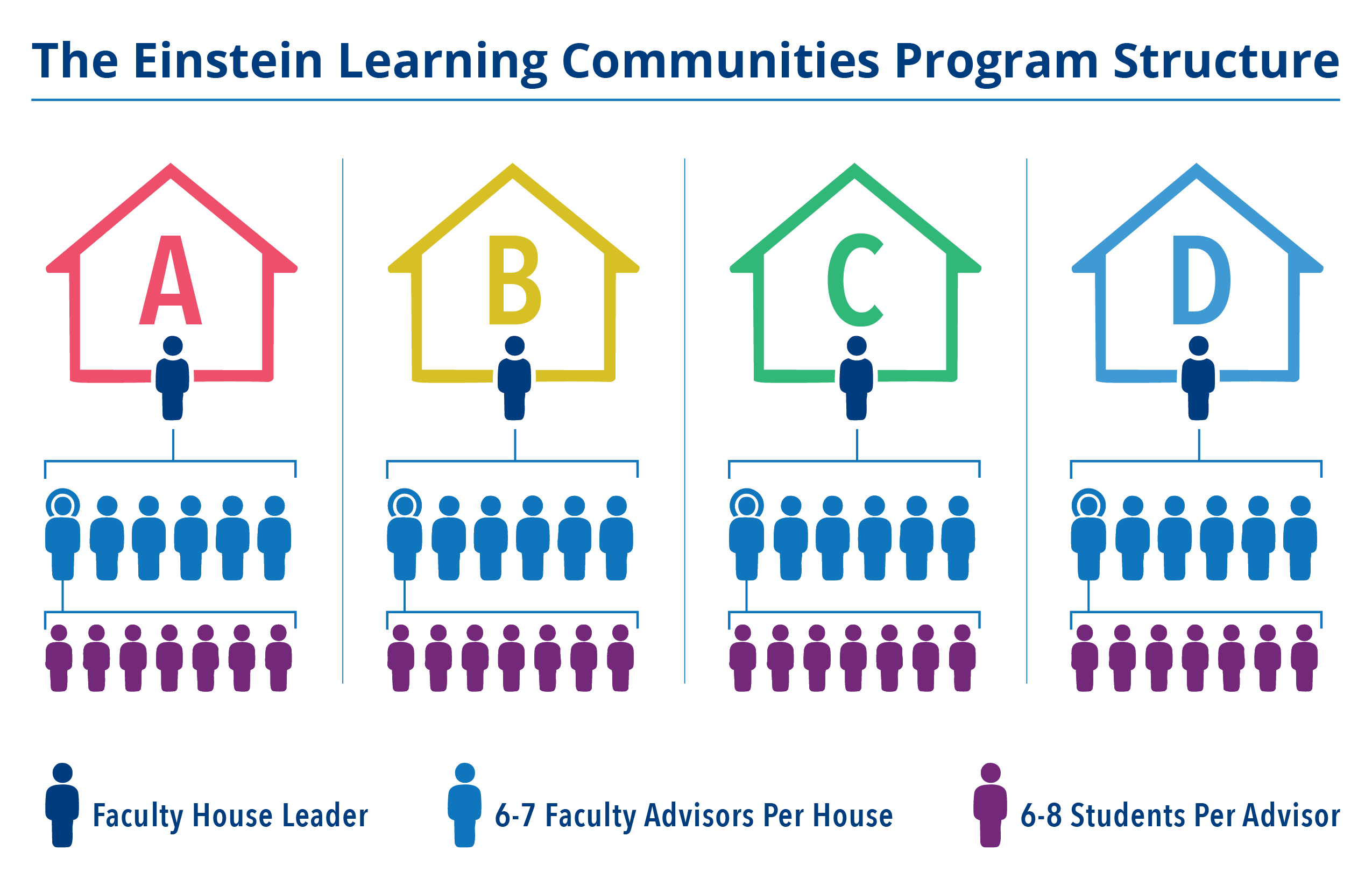 The incoming first-year class is divided into one of four houses—A, B, C, and D—each set up with six to seven dedicated faculty advisors, including a house leader. Each faculty advisor is assigned six to eight students, and these small groups remain together for four years.
Sandra Oza, M.D., M.A., who had been co-directing Einstein’s Introduction to Clinical Medicine and Transition to Clerkship courses for several years, was appointed ELCP’s inaugural assistant dean in late 2023 by Yaron Tomer, M.D., the Marilyn and Stanley M. Katz Dean at Einstein and chief academic officer at Montefiore Einstein. “ELCP was designed to address the needs for clinical skills instruction, for career advising, and for building a support network across the years,” says Dr. Oza.
“When Dean Tomer came into his role here, he really wanted to make the Einstein Learning Communities Program happen,” says Dr. Oza. “He saw its potential to improve many aspects of medical education.”

Dr. Tomer says a major function of the ELCP is “supporting Einstein students’ development into highly competent and compassionate physicians who can effectively respond to the needs of our patients and communities.”
Yoon Kang, M.D., vice dean for education and a professor of medicine at Einstein, adds that the ELCP creates an environment that “gives students the opportunity to succeed by fostering connections among their peers and the faculty.”
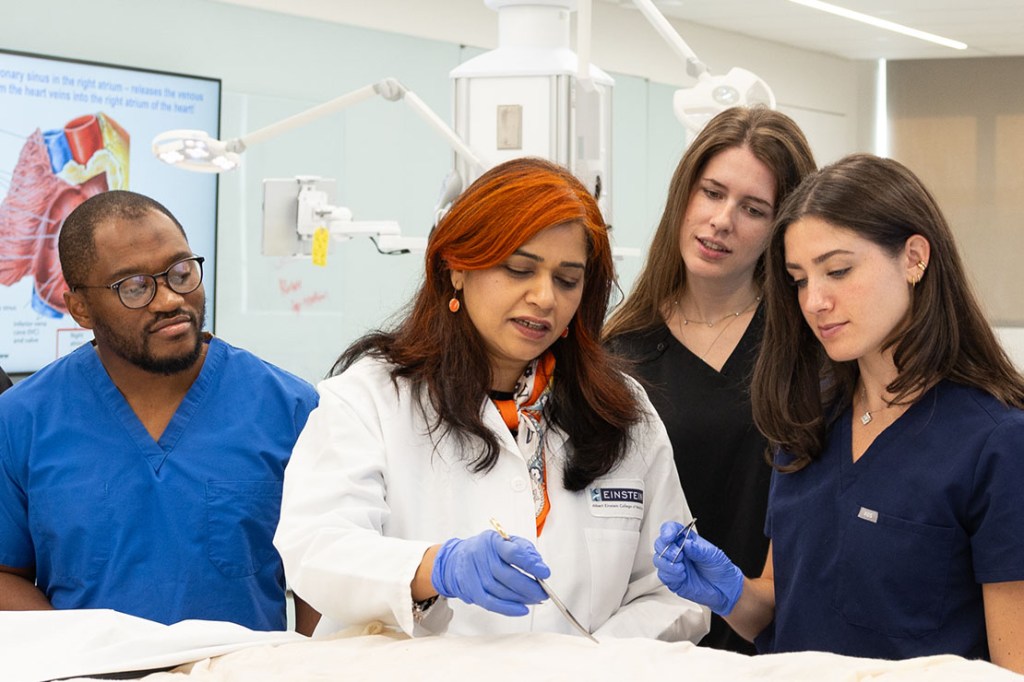
The ELCP divides each incoming first-year class into four houses—A, B, C, and D—each set up with six to seven dedicated faculty advisors, including a house leader. Each faculty advisor is assigned six to eight students, and these small groups remain together throughout the four years of medical school. The faculty advisors devote about a day and a half of their time to the ELCP each week.
“One of the things that sets this program apart from similar structures in other medical schools is that we are teaching across the clinical skills, including physical diagnosis, communication, reasoning, and presentation, as well as advising,” says Carol Bernstein, M.D., one of the four ELCP house leaders and a professor of psychiatry and behavioral sciences and of obstetrics & gynecology and women’s health at Einstein.
 Cassidy Adams, Einstein second-year medical student
Dr. Bernstein especially likes the small-group aspect of the ELCP. “I really got to know the seven first-year students I advised [now second-years], and the ELCP gave us a much more personal connection. I had students to dinner at my house. I watched the group gel through the course of the year—really become a group. The students say they really like this, because they feel connected to the faculty.”
This closer bond fosters trust, Dr. Bernstein says. “Medical school is challenging, and this new program gives us the time to help students navigate those years. If students get stuck, we can run interference. We can help direct them to the full panoply of resources.”
What Dr. Bernstein especially appreciates, she says, is that instead of the ELCP being a voluntary commitment, faculty are now given protected time to work with students. “My passion is creating good doctors. That’s what my career has been about. I think it’s wonderful that Dean Tomer did this, that we pay our faculty to teach,” she says. “It’s incredibly enlightened. It’s so different when it’s part of your job, and these faculty are all invested in this program. They come from a variety of disciplines and experiences, from people recently out of training to senior people like me.”
Faculty advisor Debayan Guha, M.D. ’19, agrees. “Einstein has made an investment in us, which has changed the way we approach the program. It tells me that the College of Medicine has decided that my efforts are meaningful and that I can make a difference in these students’ lives.”
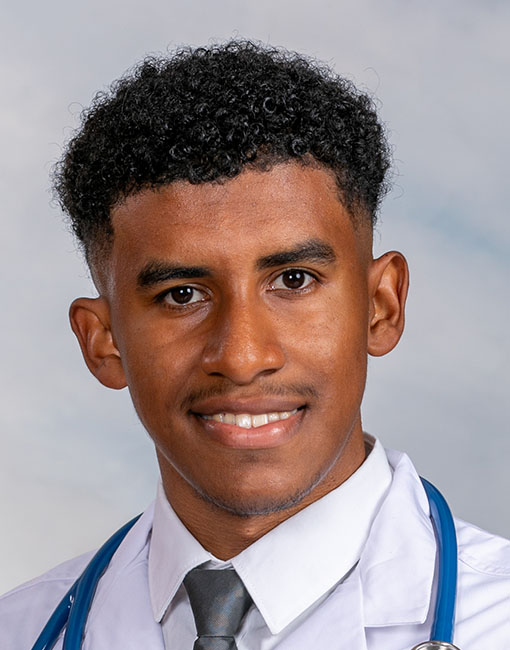 Jalen Crespo, Einstein second-year medical student
One of the faculty members on Dr. Bernstein’s team (House C) is Eugene Palatulan, M.D. ’17, M.A., an assistant professor in the Arthur S. Abramson Department of Physical Medicine and Rehabilitation at Einstein and an attending sports medicine physician at Montefiore Einstein. “I wish I had had this program when I was a student at Einstein,” he says. “I’m one of those med students who didn’t really talk much. But now, thanks to our smaller groups, everybody is really encouraged to voice their opinions.”
Ms. Adams is grateful for the positive reinforcement she got during learning sessions within her small group of students and faculty advisors. “Otherwise, the feedback I received later from the standardized patient encounters would have discouraged me a lot more,” she says. “Our advisors were able to break things down and show us how we could improve. It made the learning process seem a lot more hopeful.”
In addition to Dr. Bernstein, the other three house leaders are Dr. Oza, who also is a professor of medicine in the division of general internal medicine and an internist at Montefiore; Jordana Kritzer, M.D., an assistant professor of emergency medicine at Einstein and a physician at Montefiore, and Peter Shamamian, M.D., a professor of surgery at Einstein and the vice chair of quality improvement and performance at Montefiore.
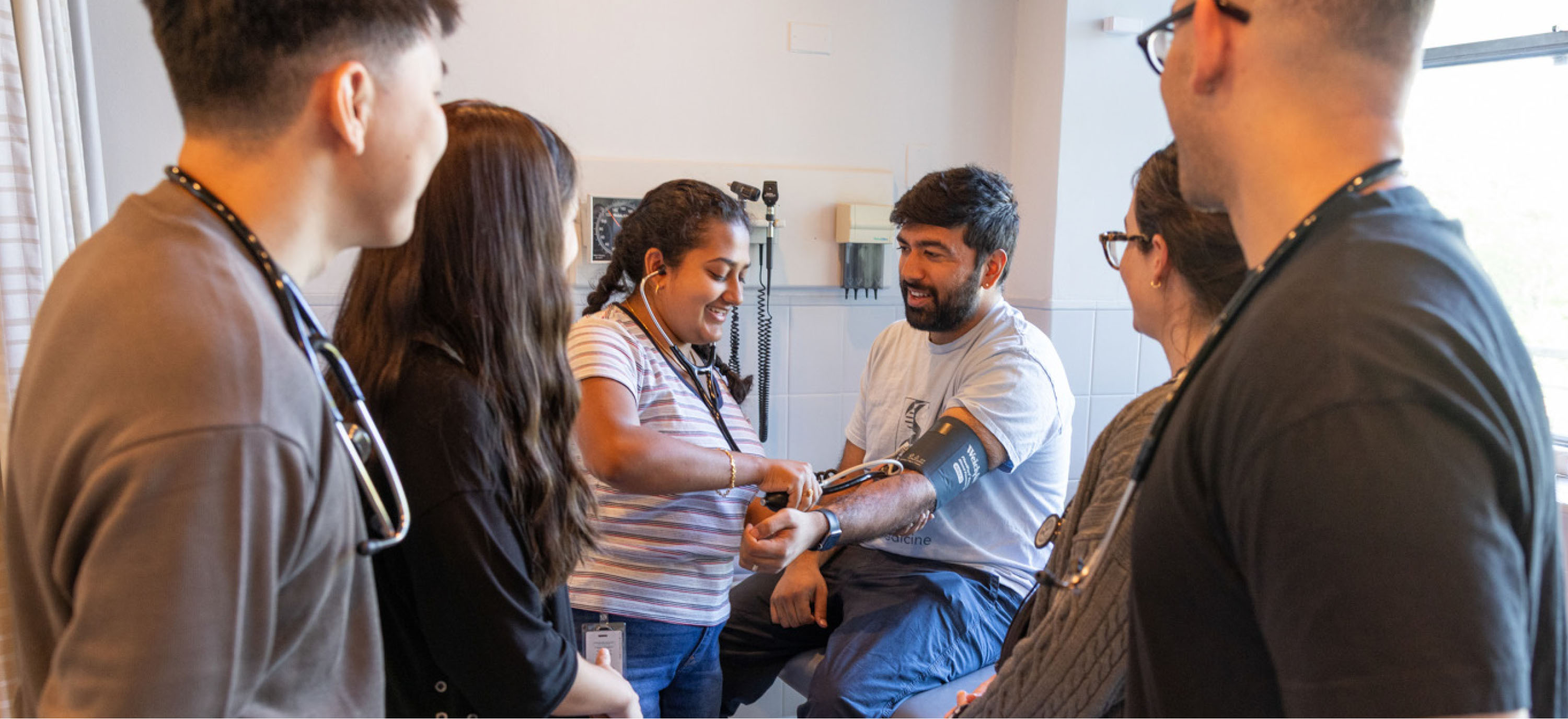
 Jordana Kritzer, M.D., leader of the ELCP's House B, instructs first-year medical students on how to perform a finger-to-nose test, a diagnostic tool in a neurological exam.
Mr. Crespo praised Dr. Shamamian, his advisor, for suggestions on how to talk to patients, how to interact with them physically, and even how to enter a room. “I found that advice extremely helpful, especially coming from an experienced surgeon.
“Dr. Shamamian is always open to talk, even if he isn’t on-site,” Mr. Crespo adds. “And he gives his time to help my classmates and me regarding curricular problems or personal problems, such as how to navigate medical school. With the ELCP, you always have a shoulder to lean on, whether it’s with your peers or with your mentor.”
Einstein first-years are assigned to different clinical sites in the fall to practice what they’ve learned in the classroom. When Mr. Crespo was doing an observed interview with a real patient in the hospital, Dr. Oza was the overseeing preceptor. “I remember we were waiting for the bus to return to Einstein, and Dr. Oza gave me helpful feedback,” Mr. Crespo recalled. “She suggested asking patients open-ended questions rather than yes-or-no questions so that patients could share more information with me. I carried that advice with me when I did other patient interviews, and it helped.”

Dr. Palatulan and Dr. Guha credit Dr. Oza with creating a collaborative culture among the faculty advisors. “We are teaching each other and learning from each other,” says Dr. Guha, who is an assistant professor of emergency medicine at Einstein and an emergency department physician at Jacobi Medical Center. “We are encouraged to get involved and offer our opinions and our expertise. We get a chance as the faculty to help each other and grow.”
Ms. Adams says the ELCP house leaders “put a lot of effort into choosing the right faculty advisors to lead us through our first year. They knew how to structure our groups and our sessions to be able to work with students from a variety of backgrounds who have different types of personalities.”
Dr. Palatulan applied to be an ELCP advisor at the urging of his department chair, Matthew Bartels, M.D., M.P.H. “Dr. Bartels told me that he thought I would be a great fit for the job, and I really appreciate that he encouraged me to apply,” Dr. Palatulan recalls. “I needed the approval of my department chair, and his encouragement allowed me to overcome any hesitation I had to apply because it meant giving up a day and a half of my clinical time.”
He said the application process was extensive, including a panel interview with Dr. Oza, Allison Ludwig, M.D., the associate dean for student affairs and a professor of medicine at Einstein, and medical students. “They really vetted the faculty,” he says. “But I’m so glad I am a part of this now.”
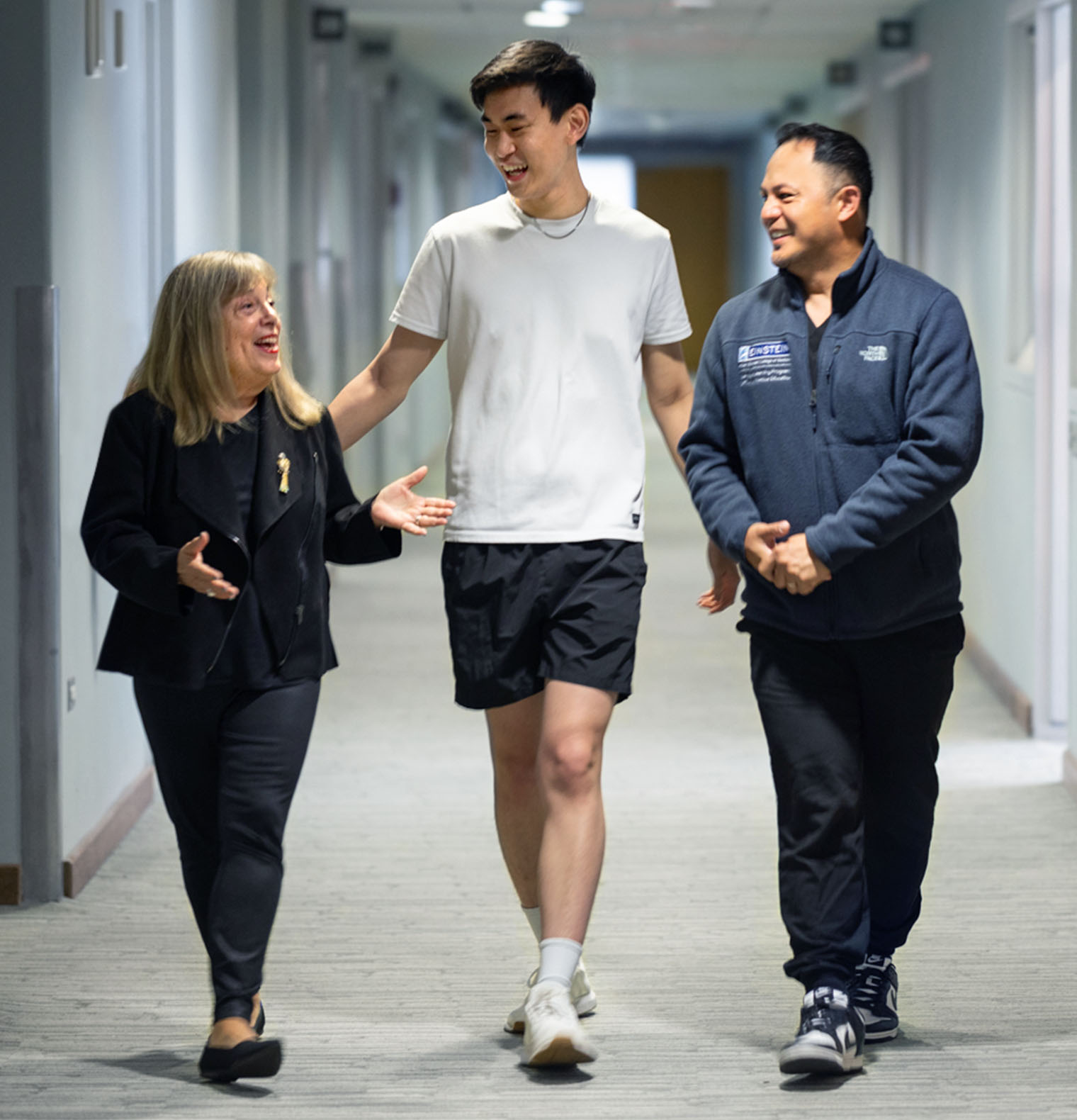 ELCP House C leader Carol Bernstein, M.D., walks with Einstein second-year medical student Kevin Wang and faculty advisor Eugene Palatulan, M.D. '17, M.A.
Along with the clinical skills instruction, ELCP presents opportunities for career guidance and mentorship. “I felt a lot of pressure at the beginning of the school year to get connected with potential research mentors,” Ms. Adams says. “And I wasn’t making much progress. But my advisor, Dr. [Robert] Shochet, [M.D.,] was able to sit down with me in his office and type up an email and help me make a connection. He was there for me.” Dr. Shochet is a senior advisor for medical education and student affairs and a professor of medicine and of psychiatry and behavioral sciences at Einstein.
The ELCP network has also helped open doors for students. During his weekly meetings with his student group (nicknamed “P-Pod”), Dr. Palatulan learned that Kevin Wang, Class of 2028, was interested in specializing in dermatology oncology and was looking for a summer shadowing experience. Dr. Palatulan remembered a classmate from Einstein, Lavanya Mittal, M.D. ’18, who completed her residency at Montefiore and is now a dermatologist at Memorial Sloan Kettering (MSK) specializing in oncodermatology.
“We stayed in touch via social media groups,” Dr. Palatulan explains, “so I reached out to her on behalf of Kevin and made the introduction. Lo and behold, he got a two-week observership at MSK this past summer. I’m glad I had the Einstein alumni connection network to tap into as an ELCP advisor. It worked out really well.”
Beyond academics and advising, the ELCP periodically offers several class-wide social activities so that students from each house can better get to know students in other houses. To close out the year, the ELCP hosted a House Olympics in the Falk Recreation Center sponsored by the office of student affairs.
“It was a way to get us together and build some camaraderie within houses as well as engage in friendly competition between houses,” Dr. Palatulan says. “Each house wore shirts with its team color, and it was a lot of fun.” All four groups competed in sports such as volleyball and kickball as well as activities such as chess and debate, with faculty serving as referees and moderators. “Our house, House C, won,” Dr. Palatulan says proudly. And the secret to its success? “It was Kevin Wang. He’s a chess master, and he won a lot of points for us!”
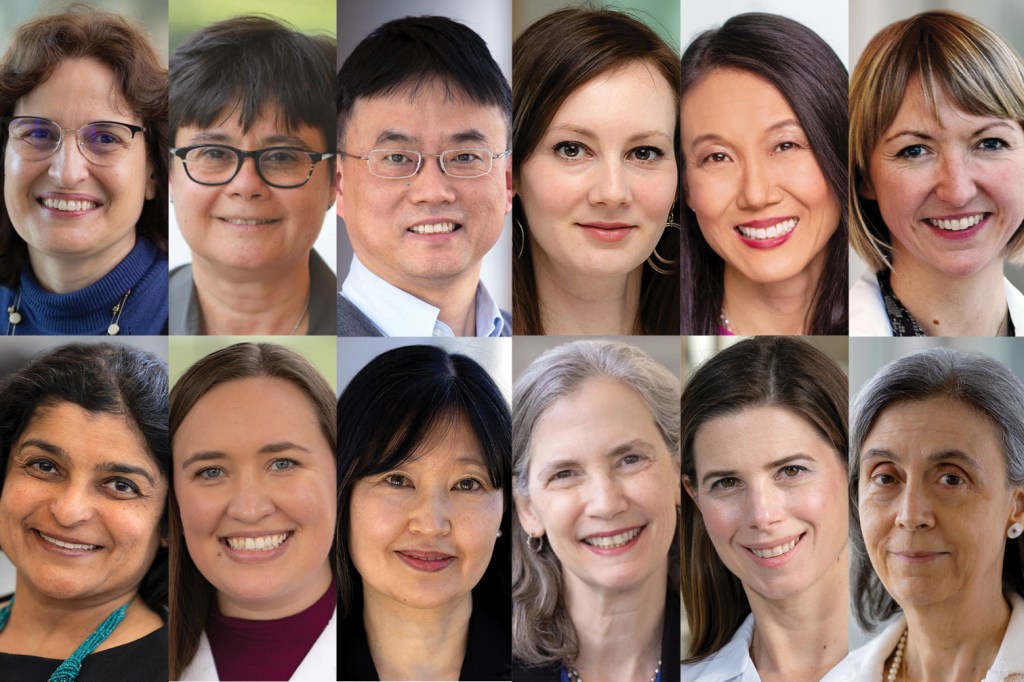
Faculty advisors in the Einstein Learning Communities Program, listed below, offer medical students a wealth of expertise from a variety of fields.